
CNC Machining Services
CNC Machining Services — milling, turning, mill-turn and grinding from Dongguan. Tolerances: ±0.003 mm milling, ±0.002 mm turning — ISO 9001 / IATF 16949 verified.
CNC machining services are mispriced when the ex-works number is the only number read. This page covers what a defective part and a late shipment really cost once they leave the supplier.
What are CNC machining services?
CNC machining services are the processes a shop offers — milling, turning, mill-turn, grinding — quoted and delivered against a drawing. The honest price of a service includes what happens after the part leaves: defects, delays and line stoppages. This page measures those costs from a Dongguan plant certified to IATF 16949.
A machined part has two price tags, and most buyers only read the first one. The visible tag is the unit price on the quote. The invisible tag is everything the part costs after you send the purchase order: freight, import duty, the scrap you accept, the rework on parts that fail, the expedited second shipment when a batch runs late, and the engineering hours you burn chasing a supplier that went quiet. Add those together and the cheapest unit price frequently becomes the most expensive order.
Total cost of ownership is a simple stack. Start with the landed cost — the unit price plus freight, insurance, duty, and local handling, because that is what the part actually costs on your dock. Then add the cost of non-conformance — scrap, rework, and the inspection time you spend because you no longer trust the shipment. Then add the cost of delay — a late batch that idles an assembly line or forces a premium air-freight top-up. Then add the cost of switching — what it costs to re-qualify a new supplier when the old one fails. The suppliers that look expensive on paper are often the cheapest once that stack is added up.
There is a quieter layer beneath those four. Inventory holding cost — the capital tied up in parts sitting on your shelf, the space they occupy, and the risk they grow obsolete or corrode before use — is a cost the supplier's lead time and minimum order quantity set on your behalf. A supplier that ships fast and in the quantities you actually need lets you hold less stock, which is a saving that appears nowhere on the invoice but shows up in your cash position every month.
Why does the ex-works price mislead overseas buyers?

When you buy from overseas, the number a supplier quotes is usually ex-works: the part loaded at the factory gate in China. Your real cost is landed: that same part delivered to your dock, after ocean or air freight, insurance, import duty, and local cartage. The gap between the two is a fixed line item on every order, which means it does not shrink when the unit price drops, and it is the same whether the parts arrive perfect or arrive scrap.
That last point is the one that matters. Freight and duty are paid on the shipment regardless of quality. If a batch arrives 3% defective, you have paid duty on defective parts, paid freight on defective parts, and now must pay again to replace them. The cheaper the ex-works price, the more tempting it is to overlook the risk that converts a savings on paper into a loss on the dock. Compare suppliers on landed cost, and treat any supplier that cannot document its quality as a supplier whose landed cost is unknowable, which is itself a risk you are paying for.
The ex-works habit is seductive because it makes two suppliers look comparable when they are not. One shop quotes ex-works with no packaging, no export documentation, and no named forwarder; another quotes the same term but with crating and export paperwork included. The term alone does not tell you which obligations are covered, so two identical ex-works numbers can carry different real costs. The fix is to force every quote onto the same basis — same term, same packaging, same destination — before you compare a single digit.
What does a defective part cost once it leaves the supplier?
There is a rule of thumb in manufacturing that has survived because it is roughly true: a defect costs about ten times more to fix at the next stage of the chain than at the stage where it was made. A part that a machinist catches at the machine costs the scrap value of the stock. The same part, caught at your incoming inspection, costs the part plus the freight and the inspection hour. Caught on your assembly line, it costs a line stoppage. Caught by your customer, it costs a return, a reputation, and possibly a contract.
This is why a supplier's process capability is a cost number, not a quality slogan. A shop running at a high Cpk ships fewer defects, which means fewer defects migrate to the expensive end of that chain. The cheapest place to stop a bad part is at the machine, before it is boxed. Everything a supplier does to keep defects at the machine — SPC, first-article inspection, CMM verification — is effectively a discount on your downstream rework bill. That discount never shows on the quote, and it is worth more than most of the line items that do.
The cost of a defect also depends on how fast it can be contained. If a supplier can point to the exact lot, machine, and operator behind a bad part, you quarantine a handful of pieces instead of a whole shipment, and you do not pay to sort good parts from bad. A supplier without lot traceability forces you to treat every part as suspect, which multiplies the defect's cost across the entire order. Traceability is, in that sense, the cheapest containment insurance you can ask for.
What does a late shipment cost your assembly line?
A late part is not a scheduling nuisance; it is a compounding cost. When a machined component arrives late, the assembly it feeds either idles — paying operators and floor space for nothing — or you expedite a replacement at a premium. A missed date can also cascade into a missed delivery to your own customer, which carries penalties no machining quote can absorb. The cost of a late shipment is measured in idle hours, expedited freight, and customer trust, and it can exceed the value of the parts themselves.
Lead time, in other words, is a cost input, not a convenience. A supplier that quotes honestly — and hits the date — protects that part of your budget. A supplier that promises fast and ships late does the opposite: it converts a known schedule into an unknown expense. When you evaluate a shop, weigh its lead-time honesty as heavily as its unit price, because a date that slips is a cost you will pay in a currency your own customers remember.
The honest trade-off is between buffer stock and on-time delivery. You can protect your line by holding safety stock, but that stock is working capital sitting idle, and it decays. Or you can rely on a supplier that hits its dates and hold less. The second option is cheaper, but only if the supplier's lead time is honest — a shop that promises three days and ships in ten forces you back into the buffer you were trying to avoid. Lead-time honesty, not speed, is what lets you run lean.
What does switching suppliers cost?
The cheapest supplier is often the one you do not have to leave. Switching carries a hidden tariff that never appears on any invoice: the engineering time to re-qualify a new source, the samples and first articles you re-run, the process re-validation for a regulated industry, and the ramp-up period while a new shop learns your drawings and your tolerances. Every switch resets the learning curve, and the learning curve is paid in scrap and rework.
This is why a supplier worth staying with is worth more than its unit price. The goal of sourcing is not to win the lowest quote; it is to find a source you can keep, one that holds tolerance, hits dates, and documents both. A supplier that gets that right saves you the cost of every future switch you never have to make. It is the single largest hidden saving in the total-cost stack, and it is invisible precisely because it is money you never spend.
Switching cost also hides in the re-qualification a regulated industry demands. An automotive or medical buyer cannot simply move a drawing to a new shop; it must re-run the first articles, re-validate the process, and often re-audit the facility, all before the first production part ships. That is a fixed, often large cost paid entirely by the buyer, and it is the reason the cheapest supplier is the one you never have to leave — the switch itself is a cost center, not a savings lever.
How do tolerances and Cpk change the total cost?
Tolerance is priced like a cliff, not a slope. Hold a dimension well inside the machine's capability and it costs almost nothing. Push it toward the limit and the process slows down, the scrap rate climbs, and the price per part rises steeply. The cost of a tight tolerance is not in the material — it is in the setups, the reduced feeds, and the parts that fall out of spec. A supplier that quotes a tight tolerance without telling you what it does to the price is passing you a risk you did not ask for.
The number that tells you whether a shop can hold a tolerance repeatedly is Cpk. At this factory the standard is Ppk ≥ 1.67 at the initial study on key characteristics and ≥ 1.33 on general ones; a representative length characteristic (76.1–76.5 mm) ran at Cpk = 1.851 (one characteristic on one part, not a blanket capability claim). Capability like that means fewer parts fall outside the band, which means fewer defects migrate downstream to your rework bill. Tolerances and capability are cost data. Read them that way.
Read the tolerance band before you read the index. Cpk is a ratio of the tolerance band to the process spread, not an absolute measure of accuracy. The figure above was recorded on a length characteristic with a 0.4 mm band (76.1–76.5 mm) — wide by design. Hold the same process spread against a ±0.005 mm feature and it fails outright. Ask for the band, the subgroup count and the sampling window on every capability number a supplier quotes.
Cpk maps to a predicted defect rate, and the numbers are worth internalizing. A stable process running at Cpk 1.33 leaves roughly 60 parts per million outside the band; at Cpk 1.67 the predicted rate drops below one part per million. Each step of capability is a step in how many bad parts you will have to find, sort, and rework, which is why the capability number on a control chart is a forward price on your scrap bill, not a statistic.
How does MOQ change your exposure?
A minimum order quantity is a bet the supplier asks you to place before you know the part is right. A high MOQ forces you to buy production volume of a design you have not yet validated, which means every defect is multiplied across a whole batch, and every design change you make after the fact is paid twice. A low MOQ does the opposite: it lets you buy one part, measure it, learn from it, and only then commit.
This factory runs an MOQ of 1 piece, which changes the economics of prototyping. You can validate a single part before committing volume, keeping your sunk cost low and catching design problems where they are cheapest to fix — on one part, not a thousand. It also means the same process that made your good prototype makes your production run, so the part you approved is the part that ships. That continuity is itself a cost control.
The MOQ also sets your inventory exposure before you have learned anything. A thousand-piece MOQ on an unproven design means a thousand chances to buy a mistake; a one-piece MOQ means the first mistake costs one part. That difference compounds when you iterate, because every design change after a high-MOQ order is paid for twice — once for the parts you made and again for the parts you remade. A low MOQ is not a convenience; it is how you keep the cost of learning small.
For the calendar side of the same decision — how part complexity, finishing, and the queues behind the quote set your delivery date — see the lead times guide.
How does one accountable supplier cut hidden costs?
Every supplier handoff is a place where cost hides. When milling goes to one shop, anodizing to a second, and heat treatment to a third, you inherit the coordination overhead, the finger-pointing when something fails, and the quality variance of three different systems. Your parts travel further, your schedule has more owners, and your rework blame has more addresses. The total cost of a multi-supplier chain is the sum of its parts plus the management time you spend holding it together.
A single accountable floor removes most of that overhead. With milling, turning, mill-turn, and grinding under one roof — more than 100 machines across a 6,800 m² facility — most parts never leave the building between operations, so one system, one inspection loop, and one party answer for the result. Surface finishing and heat treatment are coordinated with qualified partners and bundled under the same invoice, so you still receive finished parts, not a pile of sub-contracts. Fewer handoffs means fewer places for cost to hide, and fewer people to argue with when it surfaces.
Accountability also shortens the loop when something does go wrong. With one floor, a defect is found, contained, and corrected inside a single system, and the corrective action lands on one owner. With several suppliers, the same defect becomes a conference call, a blame trail, and a delay while each party checks its own records. The management time a single accountable source saves you is a line item on the total-cost stack, even though no supplier invoices you for it.
How do you run a TCO comparison on two quotes?
Turn the two quotes into the same arithmetic. For each supplier, write down five numbers: the landed unit cost, the expected scrap and rework rate, the on-time history, the cost of a switch if you leave, and the management time the relationship will demand. Weight the unit price by the scrap rate — a supplier at 2% scrap is, in effect, charging you for two bad parts per hundred on top of the hundred you bought. Then add the cost of a missed deadline and the cost of re-qualifying a replacement. The result is a number you can actually compare.
Five signals a quote is hiding cost:
- The supplier cannot state the material grade, only "aluminum" or "stainless" — the price is a guess.
- The tolerance is quoted without a measured report to back it — the capability is a claim.
- The certificate number cannot be checked against a registrar — the certification is decoration.
- The secondary operations are not named — the finishing is a future surprise.
- The lead time is promised, not explained — the date is a hope, not a plan.
Run those five checks and most of the risk hiding in a low unit price falls out on its own. The suppliers that pass are the ones whose total cost you can actually see, and seeing the cost is the first step to controlling it.
The arithmetic works without knowing any supplier's prices. Take a part quoted at a unit price you will call 100. If supplier A runs 2% scrap and supplier B runs 0.5%, then A's price per good part is 100 divided by 0.98 — about 102 — before you add the freight and inspection spent on the rejects, while B's is barely over 100. Add a missed deadline and the gap widens further. The comparison never needs real currency; it needs the rates, and the rates are what a documented supplier can give you.
What should you send to get a real total-cost quote?
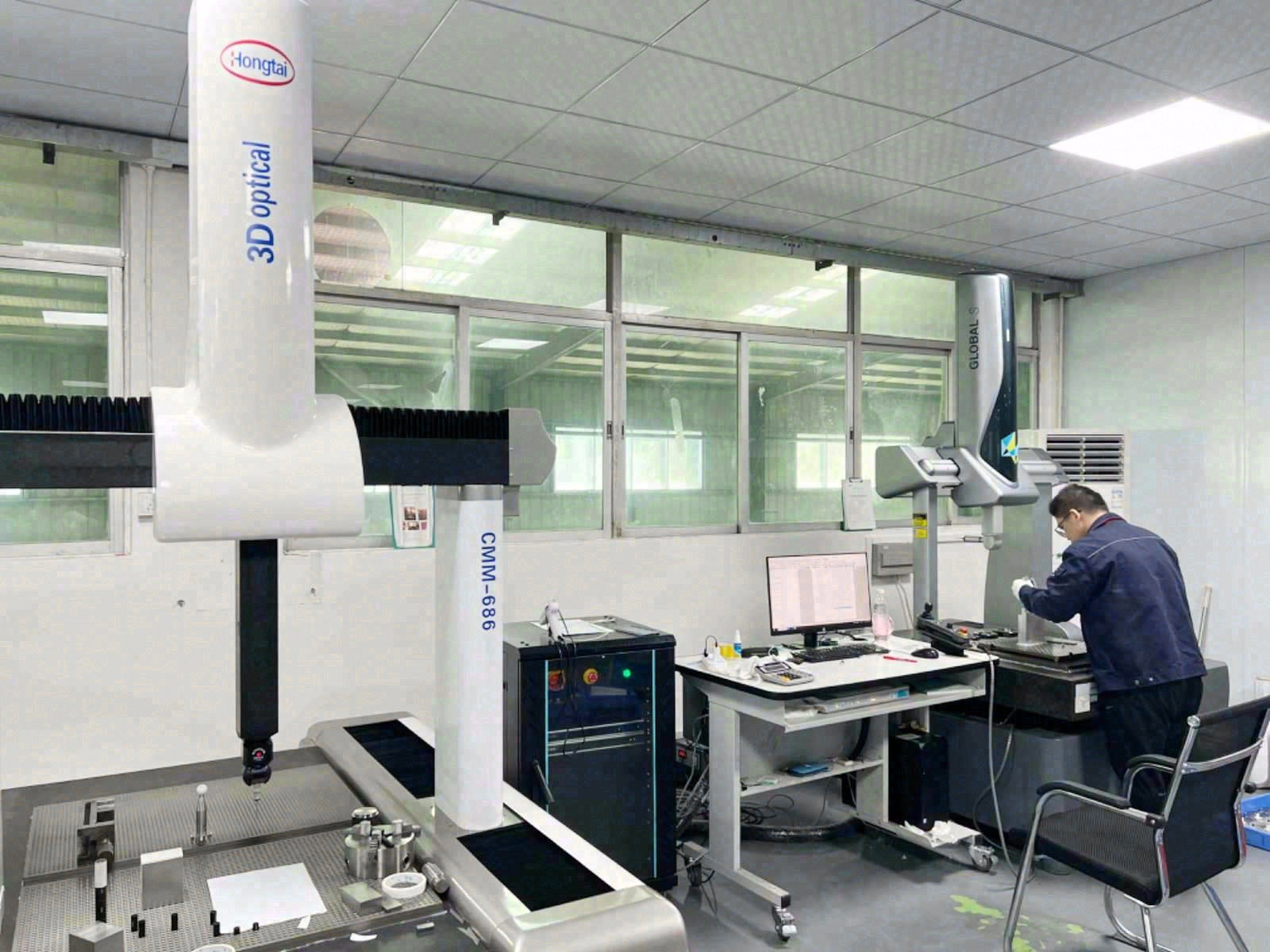
A total-cost quote starts with a drawing a machinist can price precisely. Send a STEP or IGES model plus a 2D drawing with tolerances only on the features that matter, and state the material grade, finish, and quantity in the same message. That package lets a supplier return a firm number instead of a range, and it lets you hold two suppliers to the identical part — the only way a cost comparison means anything.
Email it to [email protected] and you get a design-for-manufacturing review with the quote, usually within one business day, with any feature we cannot reliably hold flagged before cutting starts. There is no minimum order, so you can start with one part and let the total cost prove itself before you scale. That is how a sourcing decision should begin: with the full cost in view, not just the invoice.
What do Incoterms actually move in and out of the price?
When an overseas supplier quotes "ex-works," it is quoting the narrowest obligation there is: parts collected at the factory gate, with everything after that — loading, export clearance, ocean or air freight, insurance, import duty, and local cartage — becoming your problem and your cost. The ex-works number is not the cheapest option in practice; it is the quote that leaves the most cost unstated. Two suppliers can both say "ex-works" and still carry very different landed costs, because the term only fixes where responsibility changes hands, not what the freight and duty will amount to.
The Incoterms you see on a quote — EXW, FOB, CIF, DAP, DDP — are a map of that handover. Each term moves the point where risk and cost transfer from seller to buyer. Reading the map is how you stop a cheap ex-works price from becoming an expensive dock.
| Term | Seller covers | Buyer covers | Total-cost note |
|---|---|---|---|
| EXW (Ex Works) | Parts made and packed at the factory | Everything from the factory gate onward | Lowest quoted number, highest unstated cost for you |
| FOB (Free On Board) | Export clearance, delivery to the vessel | Ocean freight, insurance, import duty, cartage | Risk shifts once the goods are on board |
| CIF (Cost, Insurance, Freight) | Freight and marine insurance to the destination port | Import duty, destination handling, onward cartage | Freight is bundled, but duty is still yours |
| DAP (Delivered at Place) | Carriage to the named destination | Import clearance and duty | Seller carries freight risk almost to your door |
| DDP (Delivered Duty Paid) | Everything, including import duty | Unloading at the final address | Highest quoted price, but the most complete number |
The total-cost lesson is not that one term is best — it is that the term changes what the quote means. Ask every supplier to re-quote on the same Incoterm, or convert their numbers to a common basis yourself, so the comparison is between like obligations rather than between a partial price and a full one. A quote that cannot be restated on a single term is a quote that is hiding part of its cost.
How does material grade change the total cost, not just the unit price?
Material is the largest single lever on a machined part's cost, and it cuts two ways. The stock price differs between grades, but so does the machining speed, the tool wear, and the scrap risk, and those are total-cost items that never appear on the material line of a quote. A part specced in 7075-T6 costs more than the same geometry in 6061-T6, not only because the billet costs more but because the stronger, harder alloy cuts slower and wears tools faster. The grade you choose is a total-cost decision disguised as a material call.
The published properties below are the public data a machinist uses to plan your part. Read them as cost inputs: strength and corrosion resistance tell you whether the grade earns its keep, and machinability tells you what it costs to cut.
| Grade | Typical published strength | What it means for total cost |
|---|---|---|
| 6061-T6 aluminum | Yield ~276 MPa, tensile ~310 MPa | Fast to machine, low cost per part; the default for housings and prototypes |
| 7075-T6 aluminum | Yield ~503 MPa, tensile ~572 MPa | High strength but less corrosion-resistant; usually anodized, which adds a finishing step |
| 5052 aluminum | Yield ~193 MPa | Corrosion-resistant and formable; chosen for salt-spray exposure rather than strength |
| 304 stainless | Tensile ~515 MPa (annealed) | Corrosion-resistant but work-hardening; cuts slower than aluminum and wears tooling |
| 316 stainless | Tensile ~515 MPa (annealed) | Molybdenum adds pitting resistance for marine and chemical duty; slower again to machine |
| 4140 alloy steel | Tensile ~655 MPa (annealed) | Heat-treatable shaft and structural stock; hardening is a separate, coordinated step |
The grade also decides what happens after cutting. Aluminum alloys are anodized; stainless is passivated or electropolished; 4140 is hardened and ground. Each finishing step is a cost the raw material pulls in behind it. If you pick a grade for its published properties and ignore its machinability and finishing chain, you are pricing only the first act of the part's life.
What does the tolerance–cost staircase actually look like?
Tolerance does not price as a smooth line; it prices as a staircase, and each step down costs more than the last. The reason is mechanical: a loose tolerance falls inside the machine's natural capability, so it needs no special attention, while a tight tolerance forces slower feeds, more setups, better tooling, and a higher scrap rate as the process edges toward its limit. The cost of a tight tolerance is paid in time and rejected parts, not in material.
The staircase below is the practical form. ISO 2768 is the default for dimensions a drawing does not call out individually: the suffix letter sets the general tolerance band — c for coarse, m for medium, f for fine. When a drawing does call out a specific dimension, that number overrides the general band, and that is where the price climbs.
| Tolerance band | Typical application | Cost behavior |
|---|---|---|
| ISO 2768-c (coarse) | Non-critical clearance features | Falls within normal machine capability; negligible cost |
| ISO 2768-m (medium) | General machined parts | Standard practice; no real price penalty |
| ISO 2768-f (fine) | Fits and locating features | Needs more setup and inspection; a real but modest cost step |
| ±0.05 mm | Bearing bores, press fits | Slower feeds and closer inspection; noticeable cost rise |
| ±0.01 mm | Precision shafts, spindles | May need a second operation or grinding; steep cost rise |
| ±0.003 mm (milling) / ±0.002 mm (turning) (this floor) | Critical sealing and alignment faces | Top of the milling and turning capability; priced accordingly |
your move is to apply tight tolerances only where the function needs them and leave the rest at ISO 2768-m. Every unnecessary tight dimension is a tax you pay in setups, scrap, and lead time, and a drawing littered with tight tolerances is a signal the design was never costed. A good design-for-manufacturing review pushes back on exactly that.
How does surface finish price into the total cost?
Surface roughness is measured in Ra, the arithmetic average of the surface's peaks and valleys, expressed in micrometres. The lower the Ra number, the smoother the surface, and the more the part costs, because each step down the roughness scale adds a slower operation on top of the last. A machined surface that comes off the cutter at Ra 3.2 µm may be perfectly functional for a bracket but hopeless for a sealing face that needs Ra 0.8 µm.
| Ra target | How it is reached | Total-cost note |
|---|---|---|
| Ra 3.2 µm | Standard milling or turning | Comes with the base operation; no added cost |
| Ra 1.6 µm | Fine feed, finishing pass | Slight speed penalty; standard for general engineering parts |
| Ra 0.8 µm | Fine turning or surface grinding | A second, slower operation; used for mating and sealing faces |
| Ra 0.4 µm and below | Cylindrical or precision grinding, sometimes lapping | Steep cost and lead-time step; reserved for bearing and spindle surfaces |
Surface finish also intersects with coating. A part that will be anodized or plated can sometimes accept a slightly rougher machined finish because the coating builds on top of it, while a part left bare metal usually needs the finish machined into the surface. Specify the Ra the function actually requires, and let the finishing process — not the drawing — decide where the extra operations belong. Smoothness, like tolerance, is cheapest when it is bought only where it earns its keep.
Which DFM rules quietly add cost when a drawing ignores them?
Design-for-manufacturing is where a part's total cost is set before a single chip is cut. The same functional part can cost twice as much depending on how the drawing treats a handful of geometry details, because those details decide how many setups, tools, and operations the part needs. The rules below are the ones that most often separate a cheap part from an expensive one.
- Inside corner radii. A milling cutter is round, so a sharp inside corner forces a smaller tool, slower feeds, and sometimes an EDM step. Leave a radius at least as large as a standard cutter and the corner machines in one pass.
- Wall thickness. Very thin walls flex under cutting pressure and vibrate, which forces light cuts and risks scrap. A slightly thicker wall machines cleaner and holds tolerance with less effort.
- Hole depth. Once a hole runs more than a few times its diameter, it needs pecking, slower feeds, and better chip evacuation. Deep holes add time and break tools; drill or ream only as deep as the function needs.
- Threads in blind holes. A blind tapped hole needs clearance below the thread for the tap, or it risks a broken tap and a scrapped part. Specify the usable thread depth and leave room.
- Over-dimensioning. Every tolerance the drawing calls out is a setup and an inspection. Tolerance only the features that matter and leave the rest to ISO 2768-m.
These rules are not academic; each one maps directly to a line on the quote. A drawing that follows them machines in fewer setups, holds tolerance with less effort, and scraps less, and those savings compound across a production run. The cheapest part is usually the one whose drawing was written to be machined, not just to be measured.
Where does total cost differ across industries?
The total-cost stack is the same shape everywhere — landed cost, non-conformance, delay, switching — but each industry weights the layers differently, and you should know which layer their own industry is most exposed to.
Medical and regulated devices put the weight on traceability and documentation. A part that works but lacks the material certificate, the lot record, and the inspection history is a liability, not an asset, because a recall cannot be contained without the paper trail. Here the cost of non-conformance is not scrap — it is the regulatory exposure of a part you cannot prove.
Robotics and automation put the weight on tolerance and repeatability at medium volume. A robot joint or a gearbox housing that drifts out of tolerance does not fail alone; it takes the assembly's alignment and life with it. Process capability matters more than unit price here, because a low-capability supplier multiplies scrap across a batch that is already committed.
E-bike and consumer hardware put the weight on surface finish and landed cost at higher volume. The part must look right and survive weather, so anodizing and coating consistency matter, and a per-unit cost that looked fine on one prototype has to hold across thousands. Here a supplier that bundles finishing under one invoice removes the re-handling and re-inspection that quietly inflate the landed number.
None of these changes the arithmetic; they change which line you guard first. Your job is to know which layer of the stack their industry cannot afford to get wrong, and to weight that layer when comparing suppliers.
When does a total-cost approach fail?
Total cost of ownership is only as good as the numbers you can get, and there are honest limits. If a supplier cannot give you a measured scrap rate, an on-time history, or a real capability number, then your TCO calculation is built on guesses, and a precise-looking guess is still a guess. The method fails when the inputs are invented, which is why a supplier that refuses to document its quality is, by definition, one whose total cost you cannot calculate.
The method also fails when you mistake it for a one-time exercise. A supplier's capability and reliability drift, so a TCO figure is a snapshot, not a verdict. Re-run it when volumes change, when the part changes, or when a shipment hints that the process has moved.
Finally, watch the signals that a supplier is hiding cost rather than disclosing it:
- The quote names "aluminum" but not the grade, or "stainless" but not the 300-series number.
- The tolerance is stated without a measured report from a real job.
- The certificate number cannot be checked against the registrar's database.
- Secondary operations are folded into a lump sum instead of itemized.
- The lead time is a promise with no explanation of the process steps behind it.
Any one of those signals means a part of the total cost is being kept off the page, and the parts you cannot see are the ones that arrive as surprises.
What should you verify before trusting a landed-cost number?
Before you commit volume, run a short verification on the supplier and the number. These checks cost a few minutes each, and they surface the risk that a low unit price is hiding.
- Ask for a measured CMM or SPC report from a past job that resembles yours. A capability statement is a claim; a report with values is a fact.
- Ask for the machine list with brands and axis counts, then confirm the floor matches on a live video walk-through.
- Check the certificate numbers against the registrar. Real ISO and IATF certificates are verifiable.
- Ask how incoming material is checked — an XRF check against the mill certificate is the cheap barrier against a substituted alloy.
- Ask what happens when a dimension is out of spec. A shop with a documented non-conformance process contains a problem; a shop without one hides it.
A supplier that welcomes these checks — in writing, before you spend a dollar — is the one whose total cost you can actually see. That visibility is not a nicety; it is the difference between budgeting for a part and budgeting for a surprise.
For the full 30-minute routine that runs the same checks before you send a drawing — entity first, then machines, capability claims, and cost logic — see the online supplier screening guide.
How do you read a quote line by line for hidden cost?
A quote is a list of the operations the supplier expects to run, and the lines are where cost hides. Read it the way a machinist would, and the hidden cost becomes visible before you place the order.
- The material line should name a grade, not a family. "6061-T6" is a quote; "aluminum" is a guess.
- Setup and tooling should be separated from the unit price, or amortized and stated. A lump sum that absorbs setup hides what a repeat order will really cost.
- Secondary operations — anodizing, heat treatment, deburring — should be itemized and assigned an owner. "Finishing included" without a named process is a future surprise.
- The inspection line should name the documentation — CMM report, material certificate, SPC chart — not just "QC passed."
- The lead time should map to process steps. A date with no steps behind it is a hope; a date with a route is a plan.
Two quotes restated on these five lines become genuinely comparable, because each line corresponds to a real operation and a real risk. The discipline is the same as the rest of the total-cost method: force the hidden parts of the price onto the page, and the cheapest invoice stops being the most expensive order.
How do payment terms and currency add hidden cost?
Two of the quietest lines in an overseas order are the payment terms and the currency, and both are total-cost items that sit outside the unit price. Payment terms move cash out of your business earlier or later; a supplier that wants full payment before shipping is asking you to carry the working capital and the risk from that moment on, while terms that release payment against inspection let you pay for parts you have verified.
Currency works the same way from the other side. If the quote is denominated in a currency other than your own, the exchange rate between quote and invoice is a cost or a saving that you carry, not the supplier. State the currency and the payment schedule in the same message as the drawing, and compare suppliers on the landed number in your own currency, not on the figure that looks cheapest before the conversion.
Guides
Each guide below goes deeper on one material, industry, or decision than the total-cost overview above can.
- CNC machining services vs alternatives — which manufacturing route wins your part, and how to compare a machined quote against a printed, cast, molded, or fabricated one fairly.
- How to choose a CNC machining services supplier online — a 30-minute screen for entity, machines, capability claims, and total-cost logic.
- CNC machining services lead times — what drives the 3 / 7 / 30-day tiers, where the queues hide, and how to hold the date.
- CNC machining services: tolerances and surface finishes — what is realistic to specify by process, and how geometry and material move the numbers.
- Aluminum CNC machining services — why light, cheap parts carry disproportionate freight, and how to quote them landed.
- Stainless steel CNC machining services — ocean corrosion, passivation, and the 304/316 grade nobody checks.
- Brass CNC machining services — copper-price exposure, lead-content rules, and the scrap that pays you back.
- Aerospace CNC machining services — buying critical parts overseas without cutting the evidence chain.
- Medical CNC machining services — what a device manufacturer’s supplier evidence looks like from overseas.
- 5-axis CNC machining services — verifying complex surfaces across an ocean.
- Precision CNC machining services — when tight tolerances travel across an ocean.
What this shop actually runs
A buyer asking for capability evidence should get a specific answer. The facility behind this guide operates 100+ CNC machines across a 6,800 m2 plant in Dongguan, China, with 100+ staff. The machine list by category:
- 5-axis machining centres (10+) - Mazak VARIAXIS I-600 (510/910/510 mm travel, 12,000 rpm, 22 kW, 71.6 N·m, 30-tool BT40) and Mazak INTEGREX I-250H S (B-axis 0.0001°, 24 kW, 124 N·m, 38-tool HSK-A63). Best for compound-angle parts, single-setup multi-face prismatic work, and aerospace fittings where datum transfer loss is unacceptable.
- 3-axis / 4-axis machining centres (50+) - Brother SPEEDIO S500Z2N / S700Z2N (10,000 rpm, 14/21-tool ATC, 0.7 s tool-to-tool, Z-axis 2.2 G) and Mazak VCE-430A L / VCE-570C L (10,000 rpm, 118 N·m, 24-tool ATC). Best for prismatic parts, plates, brackets, housings.
- 100+ production machines — Mazak / Brother / Tsugami / Star / Citizen class, across a 6,800 m² facility (3-axis 50+, 4-axis 20+, 5-axis 20+, 25+ lathes, 7+ grinders, 20+ inspection instruments).
- Measured, not claimed: ±0.002 mm, verified on Hexagon CMMs. Per-characteristic capability is Ppk ≥ 1.67 initial and Cpk ≥ 1.33 production (≥ 1.33 general). Reports name the feature, band, sample size, sigma method and window.
- Three certificates — ISO 9001:2015, IATF 16949:2016 (design excluded) and ISO 14001:2015, all held by Dongguan Zhuohang Ltd, the entity that invoices you.
- Order terms: minimum order one piece, with 3-, 7- or 30-day lead times depending on how involved the part is.
- Machine highlights - VARIAXIS I-600: one-setup multi-face 5-axis + MAZA-CHECK auto-calibration; INTEGREX I-250H S: DONE-IN-ONE mill-turn, B-axis 0.0001° + Ai thermal shield; SPEEDIO S500Z2N / S700Z2N: Z-axis 2.2 G + 0.7 s ATC; Swiss-type: guide-bush switchable + 0.1 µm resolution.
Tolerance bands held: ±0.003 mm on CNC milling, ±0.002 mm on CNC turning, ±0.002 mm on precision grinding and wire EDM. Capability indices: Ppk >= 1.67 initial on key characteristics; Cpk >= 1.33 ongoing in production.
Certifications: ISO 9001:2015 (116024/A/0001/UK/En), IATF 16949:2016 (131941/A/0001/SM/En, design clause 8.3 excluded - disclosed openly), ISO 14001:2015 (116024/B/0001/UK/En). Certificates are issued to Dongguan Zhuohang Ltd (USCC 91441900MA4UWT6X39, established 2005).
Service area: Austria, Belgium, the Czech Republic, Denmark, France, Germany, Greece, Hungary, Ireland, Italy, the Netherlands, Spain, Sweden and the United Kingdom in Europe; Brazil, Canada, Mexico and the United States in the Americas; China, Israel, Japan, Singapore and Sri Lanka in Asia; Australia and New Zealand in Oceania; and South Africa in Africa. Based in China, serving customers worldwide.
Contact: Felipe Iglesias, [email protected], +86 13126536955.
Ready to see the full cost, not just the invoice?
Send your drawing to [email protected] or call +86 13126536955 for a total-cost quote and a design-for-manufacturing review.
Frequently Asked Questions
What is the real total cost of a CNC machined part?
In short, The total cost of ownership is the landed unit price — the unit price plus freight, insurance, import duty, and local handling — plus the cost of everything that can go wrong after the invoice: rework on parts that fail inspection, expediting charges when a batch runs late, and the engineering time spent switching suppliers. Buyers who compare only the ex-works unit price ignore the larger half of the bill.
Why exactly does the ex-works price mislead overseas buyers?
In short, The ex-works price is the number at the factory gate, before freight, insurance, import duty, and local handling. A lower ex-works figure can hide a higher landed cost once those charges and the risk of rework and delay are added.
What does a defective machined part cost once it ships?
In short, A bad part costs roughly ten times more to fix at your assembly line than it does at the supplier's bench, and far more again if it reaches your customer. Rework, line stoppage, and field returns multiply the original defect.
How do tolerances change total cost?
In short, Tolerances are priced non-linearly. A tight dimension the process can hold easily costs little; a dimension near the machine's limit adds setup, slower feeds, and higher scrap.
What is your minimum order quantity?
The MOQ is 1 piece. You can validate a design on a single prototype before committing production volume, which keeps your sunk cost low and lets you catch a design problem before it becomes a production-line problem.
What are your lead times?
In short, Roughly 3, 7, or 30 days depending on part complexity and the number of process steps. Simple parts ship in about 3 days; complex parts with 10–20 process steps or surface finishing fall into the longer 30-day tier.
What certifications do you hold?
In short, ISO 9001:2015 (No. 116024/A/0001/UK/En), IATF 16949:2016 (No.
How do I get a total-cost quote?
Send your STEP or IGES model and a toleranced 2D drawing to [email protected], with material, finish, and quantity. You receive a design-for-manufacturing review and a quote, so you can price the part accurately before committing.
Which Incoterm should I ask for in a quote?
In short, Ask every supplier to quote on the same Incoterm, or restate their numbers on a common basis yourself. EXW leaves the most cost unstated because you carry everything from the factory gate; DDP is the most complete but highest number.
Why does material grade change the total cost?
In short, The grade sets both the stock price and the machining speed. A stronger, harder alloy such as 7075-T6 or 316 stainless cuts slower and wears tools faster than 6061-T6, so the same geometry costs more to produce, not just more to buy.
What surface finish do most machined parts need?
In short, Most general parts are fine at Ra 3.2 µm or 1.6 µm, which the base machining operation produces. Sealing and bearing faces usually need Ra 0.8 µm or better, reached by a slower finishing or grinding pass.
What does ISO 2768-m mean on a drawing?
In short, ISO 2768-m is a general tolerance band for dimensions the drawing does not call out individually — m is the medium grade, with f for fine and c for coarse. It lets the machinist hold undimensioned features to a standard band while you reserve tight callouts for the features that actually matter, which keeps the cost down.
How do I convert an ex-works quote to a landed cost?
In short, Add the freight, insurance, import duty, and local cartage to the ex-works unit price, then adjust for expected scrap and rework and the cost of a missed deadline. The result is the landed cost you can actually compare across suppliers.
Do you use MIL-STD-105E or ANSI/ASQ Z1.4 sampling inspection?
In short, MIL-STD-105E is the U.S. military sampling inspection standard published in 1989; it specifies acceptable quality limit (AQL) sampling plans for lot-by-lot inspection.
Standards referenced on this page
- IATF 16949:2016 — Automotive quality management system standard
- ASTM B211/B211M-19 — Standard Specification for Aluminum-Alloy Rolled or Cold Finished Bar, Rod, and Wire
- ASTM A582/A582M-12 — Standard Specification for Free-Machining Stainless Steel Bars